frame 86 September 2026
Charles Ray’s Frog
By Harry Lowther

‘…like Audubon shooting some little bird, really only to look at it the better’.
William Carlos Williams, The Poem as a Field of Action (1948)
Charles Ray’s Boy with Frog (2009) stood in Venice at the head of the Punta della Dogana, at the confluence of the Giudecca and Grand canals, from 2009 to 2013. The sculpture marked the opening of François Pinault’s collection in the historic customs house. Ray had wanted the boy to become a permanent ‘citizen’ of Venice, but the city decided against renewing its temporary licence. In a 2015 interview, a pained Ray reflected on the sculpture’s removal, maintaining the unresolved connection between the site and the sculpture: ‘Boy with Frog was born at the Dogana. The location is in its sculptural DNA.’
This statement appears to contradict Ray’s long-held preoccupation with ‘embedment’. For Ray, embedment, rather than defining a physical space, is an abstract notion ‘disconnected from location’, which refers to the ‘geometry’ of a sculpture. Embedment is just as much about how a sculpture creates and unsettles space as how it occupies space. The key here, as Hal Foster notes, is that ‘embedment is not the same as site-specificity’. So why does Ray insist on the singularity of this sculpture and its genealogical relation to Punta della Dogana? Why is Boy with Frog’s embedding so much a part of its site-specificity? This essay takes Ray’s sentiment seriously, and proposes an account of why, beyond the immediate physical installation of the sculpture, Boy with Frog belongs in its location. By considering Ray’s sculpture alongside the intellectual and artistic histories of the Veneto, I suggest a possible interpretation and justification for the sculpture’s unique place, even after its removal. Venice, then, ought not be considered as an incidental backdrop, but a part of the formal and conceptual concerns through which Boy with Frog’s embedment can be more fully understood.
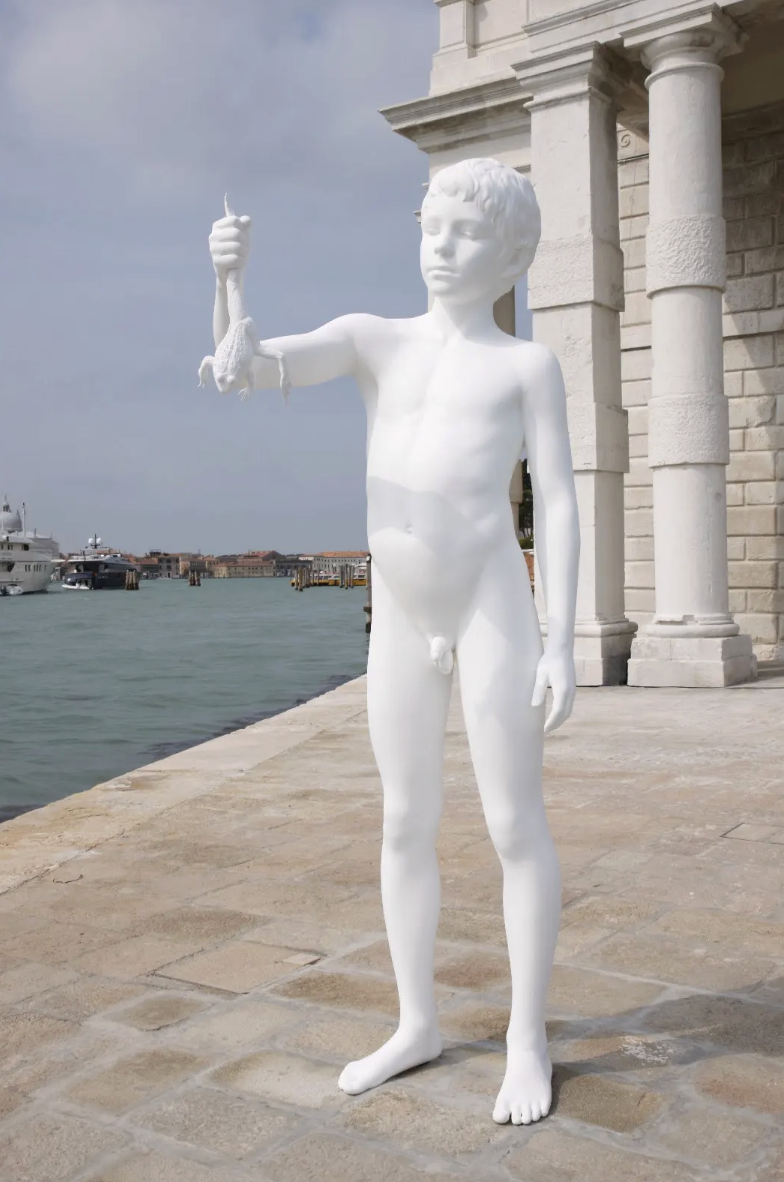
Charles Ray, Boy with Frog, 2009. Painted steel 96 x 29 ½ x 41 ¼inches, 244 x75 x105 centimeters. Photograph by Charles Ray
© Courtesy Matthew Marks Gallery
Before we understand the historical and artistic context of the Veneto, it is necessary to position Boy with Frog within its more immediate context in Ray’s oeuvre. Ray conceives of the relationship between The New Beetle(2006), Boy with Frog (2009), and School Play (2014) as a ‘loose trilogy’ that plots a ‘course’ through childhood. The suite of sculptures is based on the same sitter/model, the son of Ray’s longtime fabricator and collaborator Mark Rossi. Accordingly, the sequencing of these sculptures deals with successive periods in the boy’s development. While critics have noted this developmental trajectory, less emphasis has been placed on the nature of such a process as an aesthetic one.
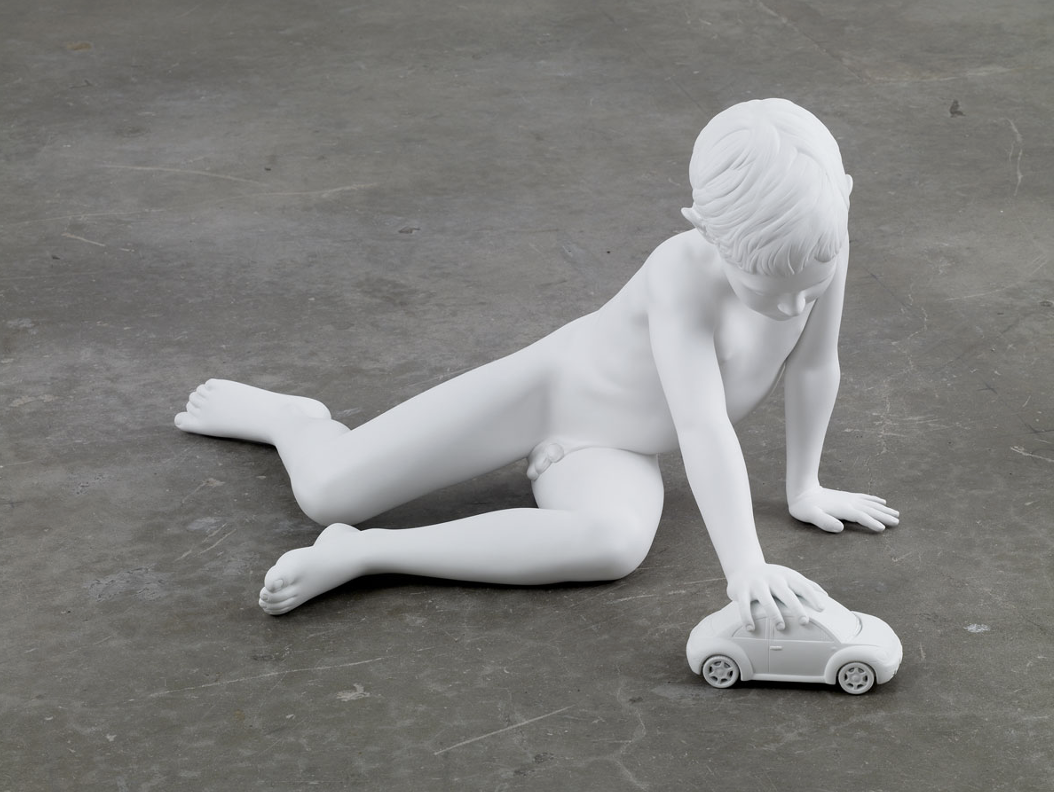
Charles Ray, The New Beetle, 2006. Painted stainless steel, 21 x 34 1/2 x 28 1/2 inches, 53 x 88 x 72 centimeters
© Charles Ray, Courtesy Matthew Marks Gallery
In a 2005 interview, Ray states that the playground constitutes ‘our first civic space’. If the playground is the initial social architecture, then play must be part of the means through which we learn to navigate this social space. This helps us to understand the progression traced in Ray’s suite of childhood sculptures, through which play becomes increasingly part of public life. This is particularly evident in the initial two sculptures, whose formal similarities and subject matter require closer comparison.
In The New Beetle a child is absorbed by a toy car with which he plays on the floor. Although appearing indifferent to his surroundings, the boy’s game transforms the environment into an unfolding space of possibility. Ray understands this emerging floor space as an ‘infinite plane’, containing ‘the past, present, and future’. The sculpture can be productively read through Schiller’s concept of the Spieltrieb [play-drive], which will help us understand the aesthetic dimension of play that the sculpture addresses. In the 14th letter of The Aesthetic Education of Man (1798) Schiller describes play as an aesthetic act capable of momentarily suspending the rational and sensuous divisions that ordinarily characterise human faculties. The transformational capacity of play is recorded in the temporary emergence of timelessness, or what Schiller describes as the ‘Aufhebung der Zeit in der Zeit’ [annulment of time within time]. For Schiller this momentary access to eternity is an aesthetic condition that permits access to the beautiful. Play, and the consequent sense of beauty derived from it, is not merely a childish phenomenon, but a necessary condition in the formation of free individuals within a given society. Through Schiller we can make sense of Ray’s infinite plane as aesthetic space: a laboratory through which societal values and meanings might be negotiated.
This process is made evident by the object of the boy’s inquiry: the VW beetle. Far from being straightforward, the car’s iconic form alludes to an ambiguous history; it is simultaneously an image of Nazi engineering and a symbol of the countercultural movement of the 1960s and 1970s. The boy’s hand awkwardly pins the Beetle between these contradictory possibilities. The boy almost certainly is unaware of these submerged histories. Ray’s sculpture, as well as being a celebration of transformative possibilities of play, is also a reminder that childhood remains subject to ideological and societal forces. To understand the boy’s development as part of a broader aesthetic education is to insist on his relationship to society at large. But The New Beetle engages with society through its form and content rather than through any particular location; its embedment is therefore not dependent upon its site-specificity. In this way, The New Beetle is a precursor to Boy with Frog, in which the developing subject steps into the civic space of the Punta della Dogana.
Although Boy with Frog shares some similarities with The New Beetle—both are white-painted steel sculptures that deal with an object of inquiry—there are also marked differences. The Boy has matured; he has taken himself from the floor, he has grown from the lifesize scale of the previous sculpture to an enlargement of about 30%, and the object of his inquiry is a living being. Why does Ray stage this encounter with a frog? And what about a frog is integral to the Punta della Dogana?
Ray makes explicit the connection between the frog and the developmental course of the boy when he says ‘[The frog is] the first animal kids cut open and look inside in science class’. The frog becomes an object through which the child learns to encounter the unfamiliar, yet it is also a living being independent of the child. According to Ray, it is an encounter with the ‘other’. If the frog invokes Ray’s childhood education in America, its position on the Venetian lagoon also places in within the history of anatomy and natural observation for which the Veneto is famed. The frog might therefore be understood as bringing Ray’s art-historical preoccupations into relation with his sensibilities as a contemporary sculptor.
During the fifteenth and sixteenth centuries, under the protection of the Venetian Republic, the University of Padua became a leading centre of animal vivisection and comparative anatomical study. Notable professors included Andreas Vesalius, whose De humani corporis fabrica libri (1543) became a landmark text in anatomical study, as well as Gabriele Falloppio, whose lectures were recorded by his student Volcher Coiter in Lectiones Gabrielis Fallopii de partibus similaribus humani corporis (1575), in which we find the frog featuring as a subject of comparative osteology. By the end of the century a purpose-built anatomical theatre had been built under the guidance of Girolamo Fabrici d'Acquapendente. This history establishes anatomical study and natural inquiry as important components of the intellectual culture of the Veneto. Ray’s anatomical interest in the frog can therefore be situated within a specifically Venetian tradition.
These developments were not only scientifically important but also influenced artistic attitudes towards animal and human forms. Ray’s frog, after all, is also a sculpture. Whilst the frog is situated within this intellectual and scientific history as subject matter, Ray’s formal concerns also embed it within a sculptural history—within a sculptural DNA. Ray’s frog can therefore be understood to unite these scientific and artistic concerns in a sculptural form. Whilst the influence of Venetian civic sculpture on Ray’s work has been well noted, especially the equestrian monuments of Donatello and Verrocchio, the history of life-casting, which grew alongside anatomical innovations, offers more persuasive justification for Boy with Frog’s embedding in the Veneto.
The first mention of life-casting in the Renaissance is found in Il libro dell’arte (written c. 1400, first published 1821) by Cennino Cennini and was likely written in Padua. The innovations in these casting techniques meant that highly naturalistic impressions could be created of small animals and creatures including crabs, lizards, birds, toads and frogs. Peta Motture notes that the growing market for the creation and collection of life-casts ‘was especially significant in the interconnection of art and nature’. The frog, then, is not only a subject of anatomical intrigue but part of a parallel history of sculpture situated in the Veneto.
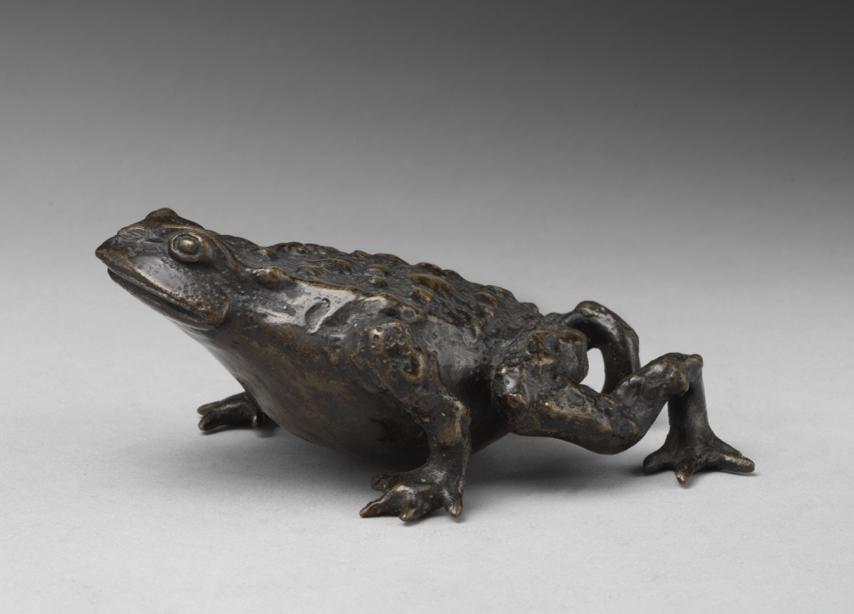
Unknown maker, Toad, possibly sixteenth century, The Metropolitan Museum of Art, New York
This history helps to contextualise Ray’s formal decisions surrounding the presentation of Boy with Frog. In an interview with Alex Israel, Ray describes three forms of representation that inhere in the sculptural configuration: the natural, the stylized, and the super-real/hyperreal. Ray attributes the third element – the hyperreal – to the frog. It is a strange blend of extreme naturalistic detail and quasi-photographic realism. Although the alienating effect of such representation can be seen as a distinctly contemporary concern, Ray’s rendering of naturalistic detail can be read alongside the specific sculptural history of life-casting. This comparison is borne out when we look at an example of a Paduan toad. The striking detail of the textured skin of the toad is retained in the casting, along with the remains of patination that give the toad its naturalistic colouring. Although Ray’s frog exaggerates these details to a point of improbability, it draws attention to the history of mimetic representation as much as to the natural world itself; it is a self-consciously sculptural object.
But why does this critical juncture occur at the Punta della Dogana? In Jacopo de' Barbari’s topographicalView of Venice(1500), we see the prior customs houses that would eventually be replaced by the Punta della Dogana, beginning in 1667. Around the triangular tip of the Dorsoduro district, we can see several merchant ships and galleons at anchor. Ray’s sculpture sits at this historic point, this juncture between the great city of the Venetian Republic and the world of commerce beyond. Ray’s sculpture can be seen as a global citizen, uniting in the brackish waters of the Venetian lagoon his own distinctly American preoccupations with the unique cultural and artistic history of the Veneto.
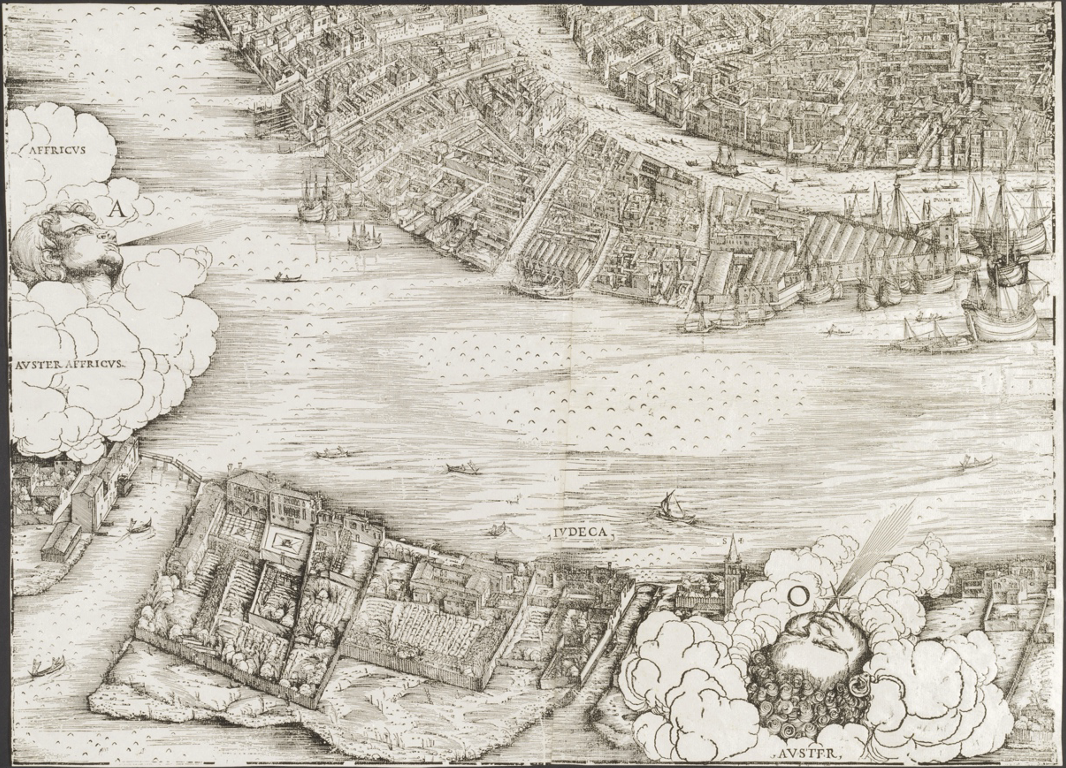
Jacopo de’ Barbari, View of Venice [lower left block], 1500, National Gallery of Art, Washington, DC.

Harry Lowther is an independent writer, researcher and curator.