

frame 80 May 2026
The Stairway That Separates My Room from My Memory
By Callum Stark

Callum Stark is a Scottish waiter living in London.
He holds a BA in History of Art from King's College, Cambridge and is currently completing an MA in Curating at the Courtauld Institute.
Image credit:
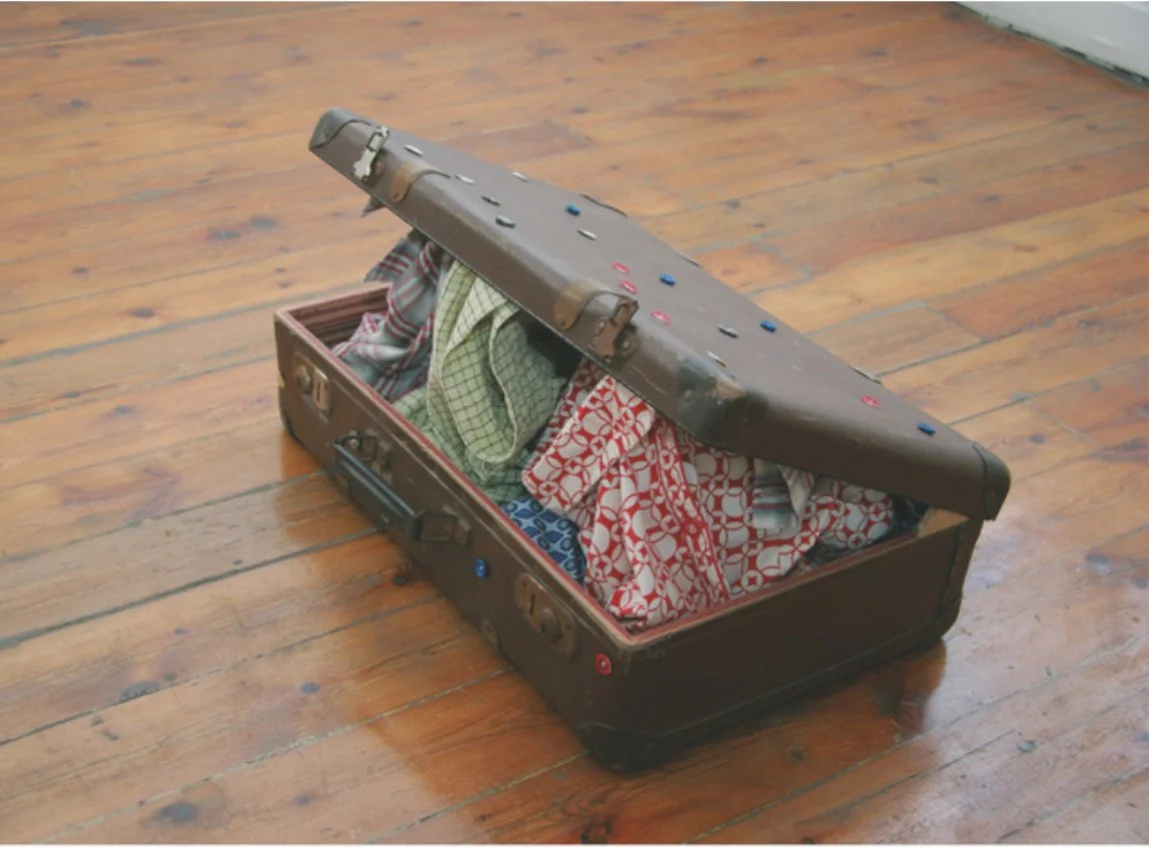
Mona Hatoum, Case, 2006
Compressed card, metal, fabric and plastic buttons 35 x 60 x 45 cm © Mona Hatoum. Courtesy Townhouse Gallery, Cairo (Photo Daina Moussa)
The Stairway That Separates My Room from My Memory
Curated by a group of Courtauld MA Curating students in collaboration with the Nicoletta Fiorucci Foundation, The stairway that separates my room from my memory examines artists’ negotiation of migration and displacement through home and homemaking. Works from the Nicoletta Fiorucci Foundation collection by Etel Adnan, Simone Fattal, Gerhard Richter, Kudzanai Violet-Hwame and Ania Soliman are joined by Mona Hatoum, Jose Garcia Olivia, Zineb Sedira Želimir Žilnik, Alya Hatta, KV Duong, Elçin Ekinci, Narges Mohammadi and Mar Kristoff. Each work is testament to its artist’s experience of voluntary or forced migration.
Arriving at this theme and these works was far from simple. With access to the Fiorucci’s collection and with the possibility of loaning further works, we had more or less carte blanche to curate an exhibition on any topic. Like the blank page, the empty gallery is a sinister thing. I’ve always thought freedom a false luxury and found comfort in constraint. Too much choice can be paralysing. It was the paint and poetry of Beirut-born Etel Adnan which finally guided us towards our theme and governed many of our choices. The exhibition’s title borrows from Adnan’s 1990 poem A Return to Earth, a Linden Tree, in which the stairway represents the liminality of the refugee existence, of being perennially caught between one place and another.
The works we selected are each bound by a politics of the in-between. This finds visual expression in Adnan’s Untitled from 2010. Following her displacement from Lebanon, the artist made homes in Spain, France and California; the muddy, pastel tones could evoke any of these places. Adnan wrote that despite being an American citizen, she never perceived her time in California as ‘exile but as an open-ended provisional situation.’ Where Zineb Sedira’s 2023 Dreams Have No Titles tapestry probes homemaking as an act of repair, Adnan’s ambiguous landscapes suggest the loss of home as a wound which can never be healed.
These works understand home as a vehicle through which to confront and affirm hybrid and irreconcilable identities. From the off we took diasporic homemaking as a practice of physical biography, thinking throughout about how possessions could be fragments of narrative and emblems of identity. Ania Soliman’s 2015 drawing Freud’s Desk places the artist’s story of migration from Baghdad to Paris in dialogue with that of Sigmund Freud from Vienna to London. The drawing presents the objects on Freud’s desk as armour to his displacement by the Nazis.
Born in Zimbabwe and now resident in London, the practice of Kudzanai-Violet Hwami is influenced by southern African popular culture, Shona cosmology and magical realism. She probes in paint the dislocations of no longer living in the country of your birth and the relationship between diaspora and the digital. Hwami’s lithograph Nzombe ne Karwe depicts the artist holding a crocodile. Karwe, meaning little crocodile, is the nickname of Emmerson Mnangagwa who replaced President Robert Mugabe following the 2017 coup which ended his thirty-seven-year tenure. The work navigates Hwami’s experience of Zimbabwe’s political instability at one remove.
Elsewhere, Mona Hatoum’s 2006 sculpture Case comprises a half-open or half-closed suitcase, clothes suspended between. Hatoum’s sculpture articulates the instability of the migrant experience and the inscription on that experience upon domestic objects.
This is explored in Inventur - Metzstrasse 11 (1975), a nine-minute video work by the Yugoslav Black Wave filmmaker Želimir Žilnik (b. 1942). The film sees the residents of a Munich apartment block recite the troubles of being a migrant worker as they walk down their shared staircase. Home is accented as a site of labour and communal resistance, the liminality of the residents’ precarious living situation paralleled with the liminality of the stairway.
This book emerged, with the generous support of Cheerio, as a textual companion to the exhibition, each essay a space to turn over its themes. My co-editor Grace Nicholson and I wished this book to be a palimpsest of sorts, for text to overlay image and image to overlay text, though also an object of its own. Where some essays attend directly to the selected works, others are discrete meditations on the theme of home and migration.
To make a book is no simple thing and this publication rests entirely on the eloquence of its contributors. A disparate crew of writers and academics, each essay has a different texture to the last. With free reign to respond as they wished, every contribution was a surprise – and a thrill. Even more unexpected were the lively and unusual ways these texts, conceived in isolation, conversed when brought together, each interacting with and colouring that before and after.
The opening essay by Dr Venetia Porter, former Senior Curator for Islamic and Contemporary Middle East Art at the British Museum, examines Etel Adnan’s negotiation of her displacement through the twin languages of poetry and paint. Adnan was raised speaking Greek, Turkish, French and Arabic, later learning English at Berkley in the 1950s. Porter traces how the poetic and political contours of each language marked Adnan’s art and writing. Where French was stained by its association with colonial occupation of Algeria, Arabic was abstracted by her imperfect understanding of the language. Adnan’s leporellos, concertinaed books combining script and image, poetry and paint, were material expression of these questions. Porter writes of how leporellos became for Adnan ‘a battle ground bound up with her own identity, where not only the words she wrote but which language she wrote them in became a political act.’
Sussan Babaie, Professor in Arts of Iran and Islam at The Courtauld, probes food as a marker and mediator of place and identity in the Islamic world. My Food, My Home mediates on food’s capacity to broker the migrant’s often provisional experience of home described by Adnan. One passage sees Babaie interrogate a seventeenth century platter from Safavid Iran, how its form and decoration give clue to the cosmopolitan identities of those who ate from it and the geopolitical context in which they did so. Babaie concludes by taking pistachios, and the equal ease with which they grow in Iraq or California, as metaphor for the migrant’s ability to accommodate multiple or contested understandings of home, to navigate the liminal or unstable.
Babaie presents home as stitched of tradition and ritual rather than geography. DBC Pierre’s Volcanic Home similarly considers human capacity to fashion home on any ground, be it the lava fields of Mexico City or the suburban fringes of Birmingham. Pierre is a singular writer, friend and traveller. He has lived a life of grand and unusual proportions and is possessed of a brain to match. When I contacted Pierre saying I had a favour to ask for my MA, he replied that he’d be more than happy to forge my degree certificate and might do one for himself while he was at it.
Born to an Australian father and English mother, Pierre was raised in a modernist mansion designed by Luis Barragán in the swishest suburb of Mexico City. This they shared with ‘five well loved staff, a thug of a raccoon, some songbirds – one of whom accompanied jazz horn improvisations – fish, turtles, axolotls and a dog.’ Pierre’s essay recounts childhood trips to England with his mother, where they would live with strange anonymity, renting down-at-heel houses and bedsits in places to which they had scant connection. He considers how, for his mother, these safaris in the country of her birth were an expression of her psychogeography. A means through which to perform and reperform lives and homes long surrendered. More universal is Pierre’s conclusion of home as built less of bricks and concrete than culture and codes.
Seen in his essay The Living Eyes of History, few are able to confront the tangle of contemporary geopolitics with such grace and depth as Oscar Guardiola-Rivera. Professor of Human Rights and Political Philosophy at Birkbeck Law School, Guardiola-Rivera’s research concerns the intersection between ethics and aesthetics. Here, he examines the incursion of global events on the individual’s right to, and search for, home. Guardiola-Rivera considers the asymmetrical ways where we come from affect where we will end up. And how art and imagination structure our understanding of these issues and aid us in puzzling through them, in digging deeper into injustice. Typical of Guardiola-Rivera is the motley gang co-opted for the ride with Suzanne Cesiare, Seamus Heaney, Nick Cave, Kant, Hegel, the offbeat jazz musician Sun Ra and even Antigone amongst his interlocutors.
Ismail Einashe is an investigative journalist and art writer, whose 2023 Tate book Strangers explored art’s mediation of migration in contemporary discourse. His essay A Wound and a Map articulates a belief which has structured the making of this exhibition, that of art as an imaginatory force. A tool equally capable of confrontation and escape, of holding dreams and reality in one hand, of visioning lost pasts, contested presents, and undrawn futures. Einashe’s essay opens with the memory of his mother burying their family photographs in the garden of his childhood home in Hargeisa, later destroyed in the Somalian Civil War. At once poetic and to-the-bone, Einashe traces the mark of these often incomplete or fragmented memories, feeling through the ways in which art has helped him organise the irreparable loss of home: ‘To the refugee, the exile and the stranger, art is a sanctuary, it is a place where they can revisit, reimagine or honour their lost homes, even if that is only possible in their imagination.’
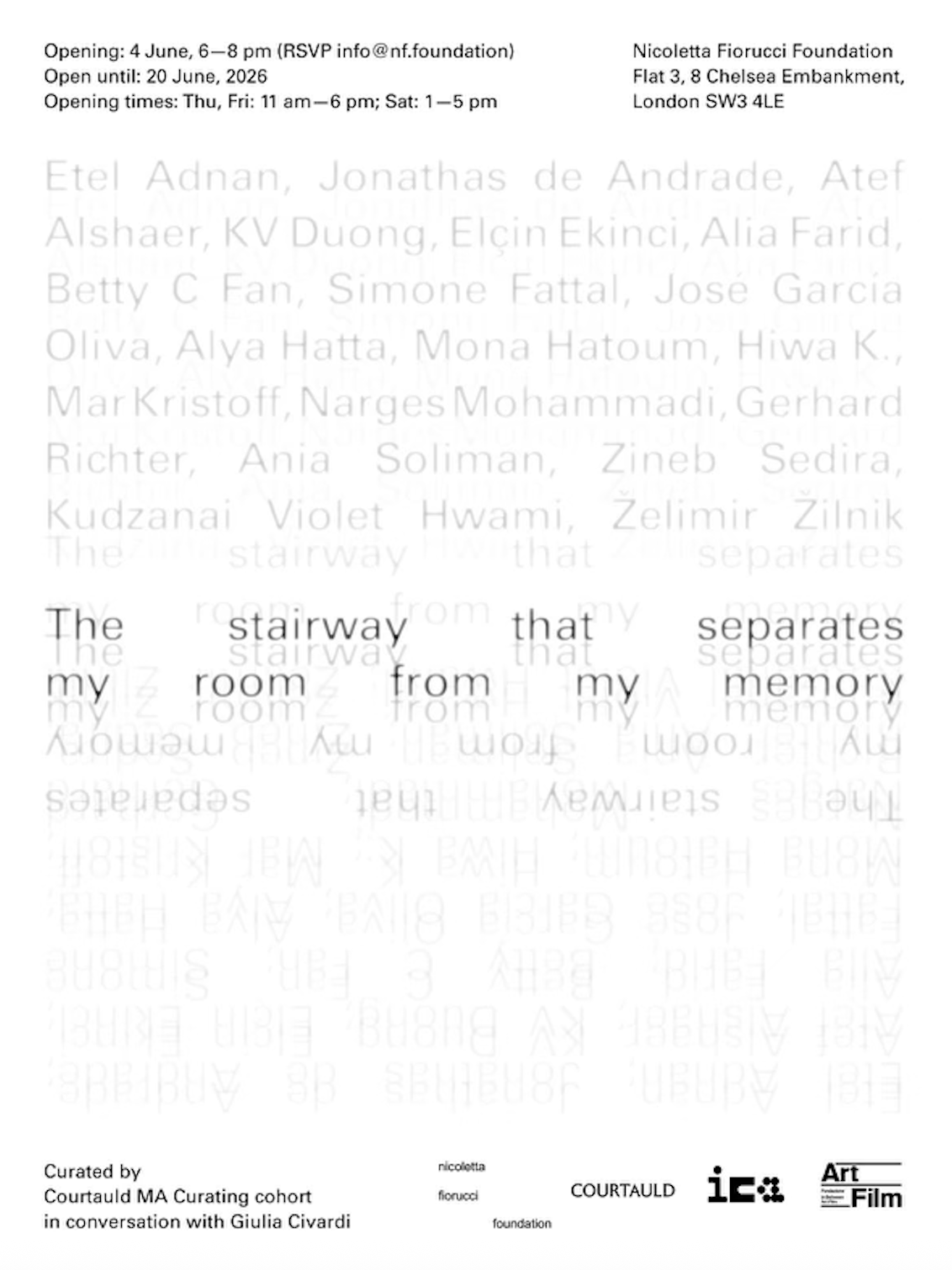
The Stairway That Separates My Room From My Memory is an exhibition hosted by the Nicoletta Fiorucci Foundation and curated by MA Curating students from the Courtauld Institute of Art. The exhibition runs from 5 June 2026 to 20 June 2026.