

frame 79 April 2026
Kafka and Goya
By Roc Sandford

Roc is a member of artists’ collectives Ocean Rebellion and Hard Art, and is author of Burnt Rain (Hazel Press, 2023) and co-author of Rebel, Rebel (Gometra, 2024). Writing, editing, profiles or interviews have appeared in Dark Mountain, Telegraph, Times, Mail, Guardian, Observer, Sun, Mirror, Scotsman, Herald, Reuters & many other outlets. Roc’s work has been the subject of documentaries & dramatisations by BBC (Krusso and Someone must be lying), Dmitri Galitzine, Arte, ZDF, RTÉ and Stacey Dooley amongst others. Roc lives on the off-grid Hebridean Island of Gometra and otherwise part time in London.
Kafka and Goya

Sueño 1°
Franz Kafka
Dearest Max, my last request: Everything I leave behind me … in the way of diaries, manuscripts, letters (my own and others’), sketches, and so on, to be burned unread … Yours, Franz Kafka.
101 years ago this April 26th, Franz Kafka’s unfinished masterpiece, The Trial, came out. Kafka had been dead for nearly a year, having asked for his manuscript to be burned. Fortunately, his executor and friend, Max Brod, disobeyed and published it instead. If you haven’t read The Trial yet, and can find the time, I’d read it now.
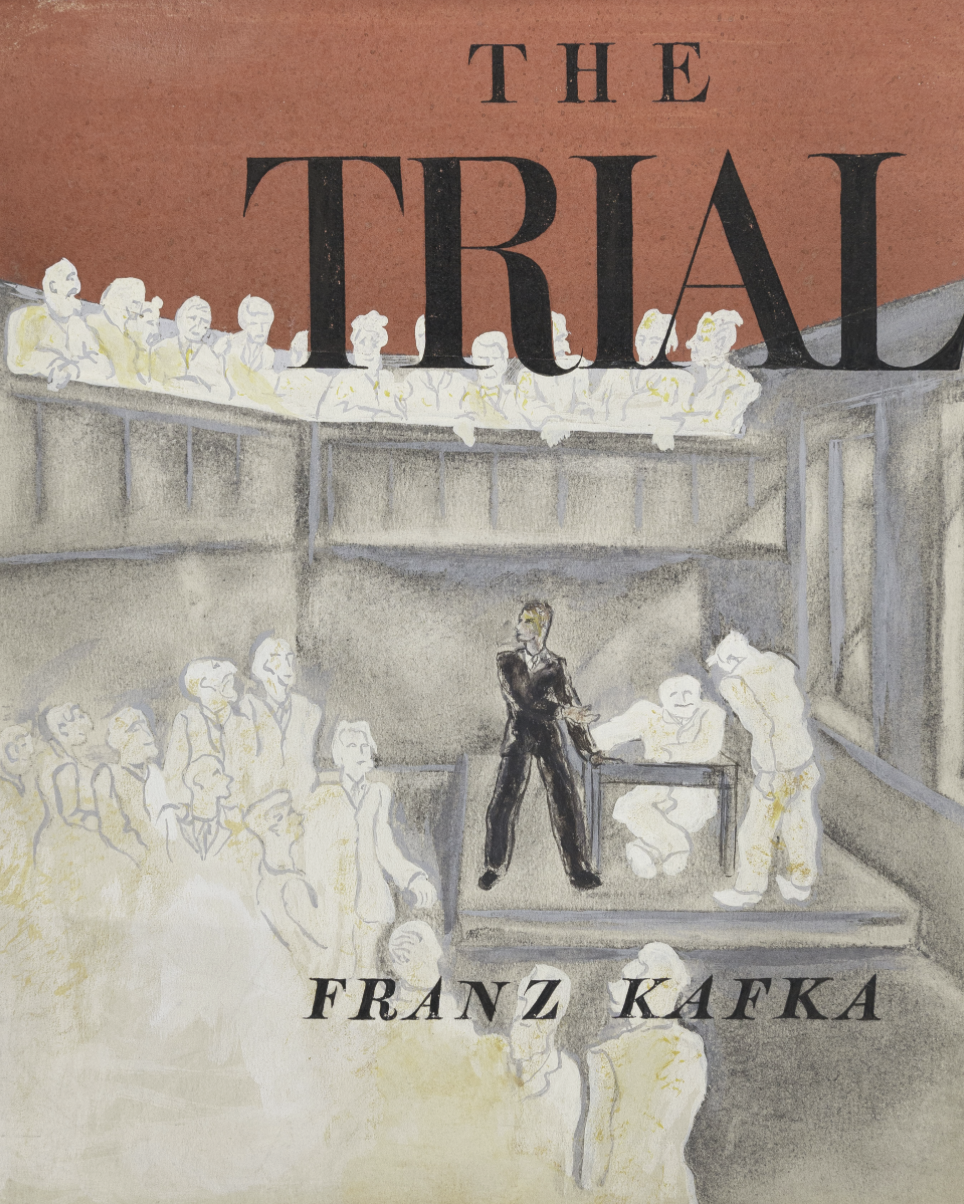
Franz Kafka, The Trial, cover design by George Salter, published by Alfred A. Knopf, 1937.
In the book its flustered hero, Josef K., is advised to seek the advice of an artist known as Titorelli. Titorelli is a court painter, preparing official portraits of The Trial’s judges and, in his spare time, painting bleak moorland scenes. I read him as living Kafka’s own life ideal: in a garret, without dependents, devoting himself to watching and documenting, as nicely as anyone could, the workings of the human ‘court,’ yet harried meanwhile by importunate young women, their faces betraying ‘a mixture of childishness and degeneracy,’ who sneak in to use his brushes to paint their own mouths red.
Titorelli is barefoot, dressed only in a nightshirt and the roomy yellow linen trousers he has donned on Josef K.’s arrival, while Titorelli’s easel also has a shirt hanging on it ‘whose sleeves dangled on the floor.’ The nightshirt, or the open necked shirt in general, seems to represent to Kafka his own practice of writing. At the start of The Trial, Josef K.’s nightshirt is confiscated by court officials, the first of whom, incidentally, is also a Franz. ‘Both of them examined K. ’s nightshirt, saying that he would have to wear a much worse one now, but that they would look after this one, as well as the rest of his undergarments, and if his case turned out well, they’d return them to him.’ The trial is a threat to Kafka’s art; or rather, threats to Kafka’s art are experienced as the trial. Yet paradoxically, these very threats provoked a masterpiece.
In a famous passage kindly Titorelli is working on a portrait of one of the court’s judges, drawing an allegorical figure of Justice as Victory behind him.
Around the figure of Justice, apart from some coloration that was barely noticeable, it remained light, and in this brightness the figure seemed to shine forward so that it now looked like neither the God of Justice nor the God of Victory, it seemed now, rather, to be a perfect depiction of the God of the Hunt.
The judges’ task is not to dispense justice, nor even to express the ‘rightness’ of might, but simply to hunt their prey. Just as, elsewhere in The Trial, the whipper’s task is simply to whip —
I am the whipper and whip I shall.
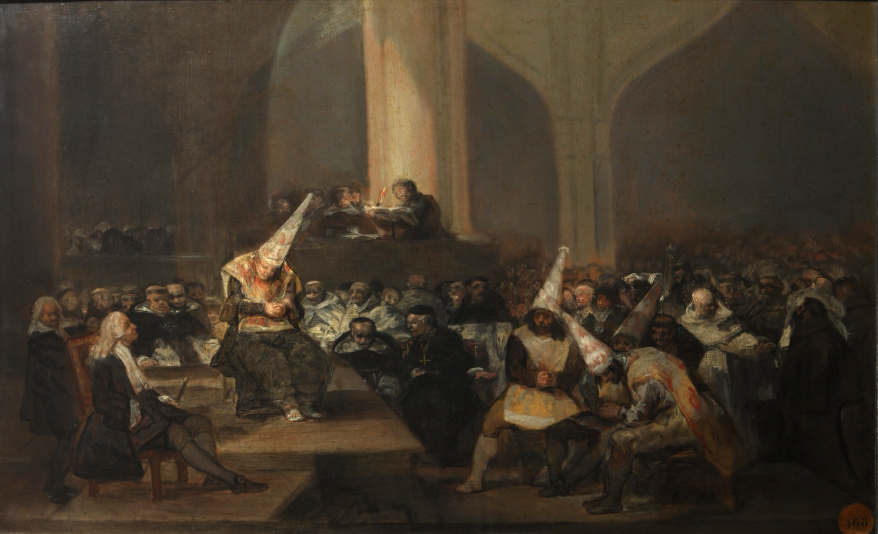
Francisco Goya, Escena de Inquisición, 1808-1812, Real Academia de Bellas Artes de San Fernando, Madrid.
Titorelli, it seems, had been suggested to Kafka by his reading of a life of Karl Stauffer. Stauffer was a portraitist of lawyers; and incidentally a teacher of Käthe Kollwitz, who documented Kafkaesque horror under the Kaiser, Weimar & the Nazis. But latterly Stauffer had become a sculptor of motion by means of stasis—a particular interest of Kafka’s. Many of Stauffer’s inner struggles echo Kafka’s own. For instance, that between Stauffer’s single-minded ambition to work night & day at his art and, on the other hand, his all too reciprocated attraction to his alluring patron, Lydia Escher.
This was an attraction whose consummation led directly, at the instigation of her powerful family, to her immurement in a lunatic asylum and his arrest for kidnap and rape; then to his attempted suicide by gunshot (he missed his heart) and to his polishing himself off with an overdose of chloral hydrate; and finally to her also poisoning herself, perhaps with morphine or else with gas, having been thwarted by her ex-husband in her attempt to leave her riches to promote ‘the independence of the female sex, at least in the field of the applied arts.’
Strangely none of this Kafkaesque horror seeped through to Kafka’s refreshing and even envious account of Titorelli, who was spared the trials of Stauffer and Escher, which yet were doubtless parked by Kafka for later consideration, or at least experienced as a warning.
The Titorelli episode forms only a small part of The Trial. As a whole, the book rings like a great bell made out of wood, hit monotonously all night with a black mallet. Only by dawn do you understand that it is not a bell but a coffin, the mallet is slowly nailing down its lid, and you are inside. Feeling not claustrophobia, but exaltation.
’Look,’ I said, ‘everything will soon be alright.’
‘It is already alright,’ Franz Kafka said slowly. ‘I have said yes to everything. In that way suffering becomes an enchantment, and death—it is only an ingredient in the sweetness of life.
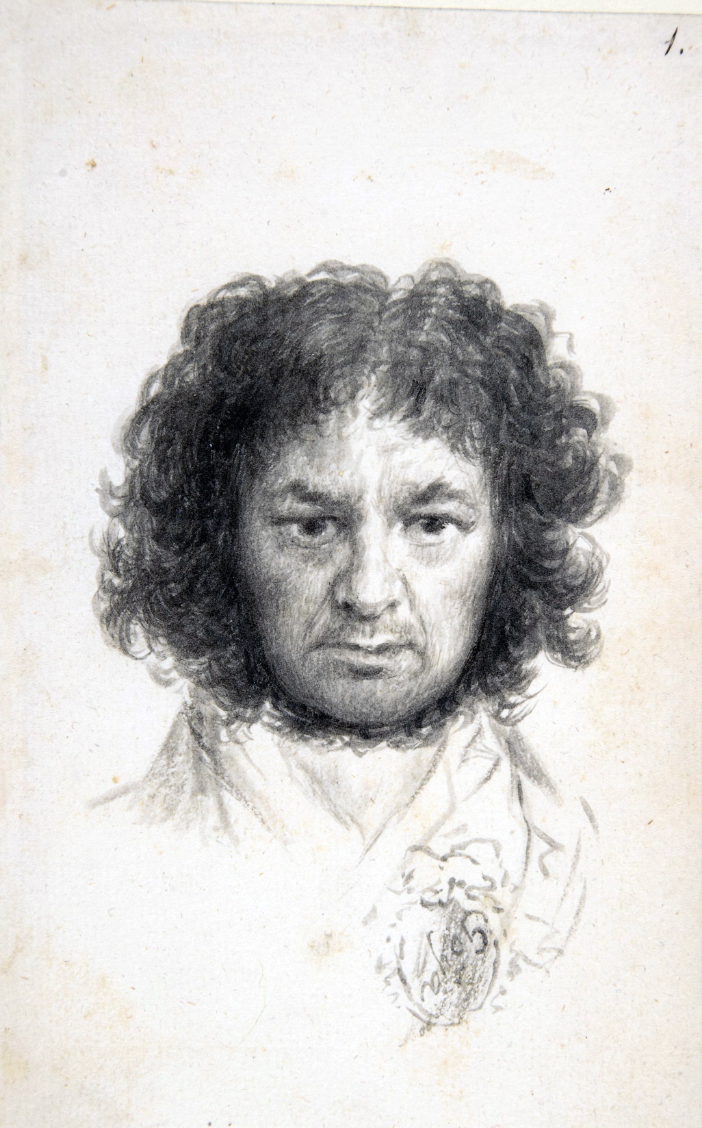
Francisco Goya, Self-Portrait, ca. 1796, The Metropolitan Museum of Art, New York.
Francisco Goya
Comme ce diable d’homme devait se trouver à l’étroit dans son costume de peintre du Roi. (Matheron.)
Another celebrated court painter, Francisco Goya, displays marked resonances with Kafka, and even with Titorelli.
Unlike Titorelli’s importunate young women, it was Goya himself who allegedly painted, at her request, her make-up onto the living face of the Duchess of Alba, the it-girl of her day, taken with his genius. ‘That is certainly more of a pleasure than painting on canvas!,’ he is said to have written.
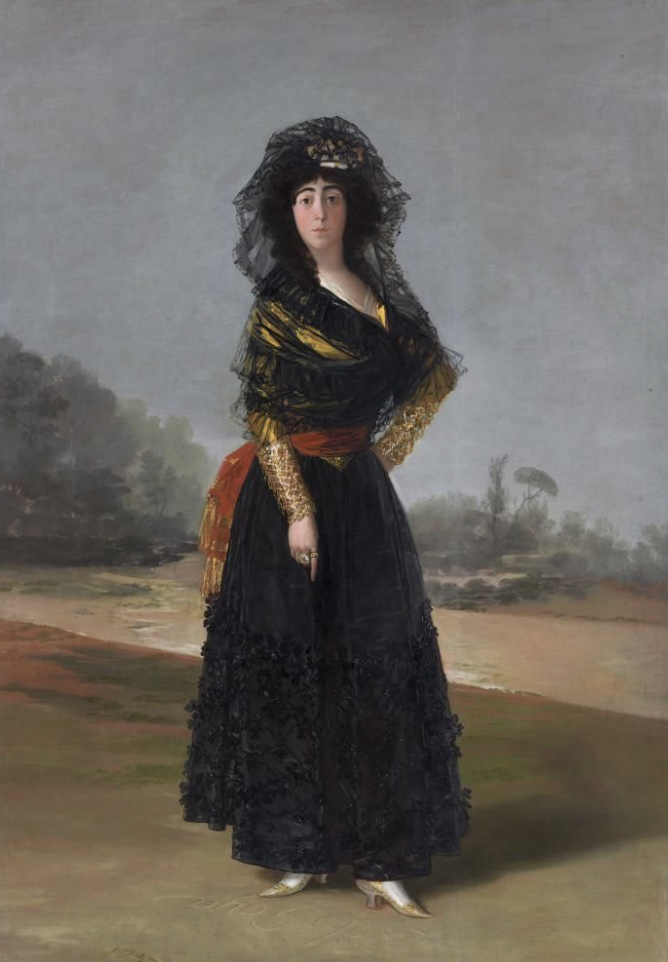
Francisco de Goya, Portrait of the Duchess of Alba, ca. 1797, The Hispanic Society, New York.
Both Goya and Kafka were horrified by the disasters of peace—amongst them, industrial accidents. El Albañil Herido, the injured mason, is an early canvas of Goya’s, while Kafka busied himself, as part of his day-job at the Bohemian Workers’ Accident Insurance Institute with preparing lists of the most common industrial manglings, whether by lathes or on building sites, together with advice on how to avert them. ‘Insurance,’ Kafka remarked in this connection, ‘is like the religions of primitive peoples who always believe they can ward off evil by all kinds of manipulations.’
Both Goya and Kafka hacked at the roots of evil by displaying its leaves. Ironically Kafka had also entered a partnership to develop an asbestos business with his brother-in-law. It’s not enough just to mean well, to deliver you also need omniscience.
Despite Goya’s adeptness in navigating the dangerous politics of the Spanish court, and his vogue as a court painter, both Goya and Kafka saw some of their greatest work go unpublished during their lives. Goya’s great Disasters of War had to wait still longer than Kafka’s The Trial for publication; in the meantime, Goya had given away his stock of canvases to make bandages for injured patriots. Each faced pushback. The Nazis placed Kafka on their index of ‘harmful and undesirable writings,’ while Ruskin burned an entire edition of Goya’s Caprichos. And on at least two occasions Goya provoked the terrifying attentions of the Inquisition whose trials, a premonition of Kafka’s, Goya nevertheless painted and printed. Goya ended his life in exile in Bordeaux, having escaped organised religion and the reactionary Spanish state, at the cost of losing Spain herself.
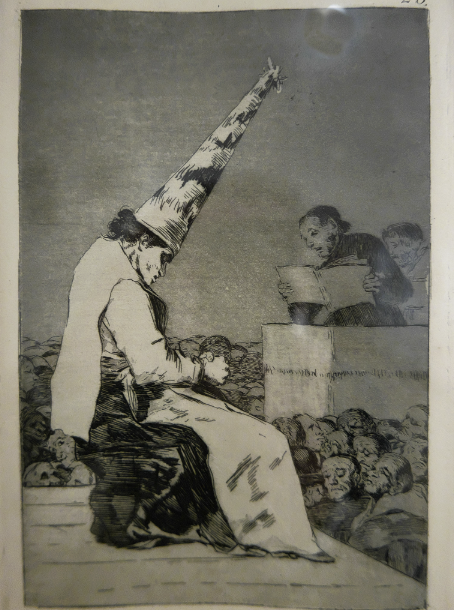
Francisco de Goya, Aquellos polvos (Plate 23 from Los Caprichos, 1797–99), Real Academia de Bellas Artes de San Fernando, Madrid.
Both Goya and Kafka were fascinated and inspired by dreams. The words Sueño 1°, ‘dream one,’ were written on Goya’s copy of El sueño de la razón produce monstruos, intended as first of the Caprichos (though I sometimes think Goya got it back to front—reason falls asleep once the monsters come); while Kafka’s ‘dream-narrative’ is clearly his central breakthrough. Brod even has an anecdote of Kafka’s telling Brod’s father whom he’d accidentally woken—‘consider me a dream.’
Strangely, both transmit, despite the horror of their subjects, a feeling of profound safety. Goya and Kafka are both trustworthy, in the sense of the primacy of truth being beyond question—which is the only spiritual state which deepens and defends the possibility of human connection as an antidote to terminal loneliness.
And finally, both shared a fascination with gesture—especially the gesture of raising your hands and spreading all your fingers wide. Numerous works of Goya’s exhibit this gesture, and at least one of Kafka’s. Amongst many others, both Goya’s Naufragio and drawing no. 23 of his Madrid Album have a woman raising her hands to the sky. The latter is dancing whilst echoing the horns in the background of a bull, that ultimate Josef K., Josef K. himself being no more than a bull who doesn’t know a bullring when he sees one. Even the tree, dressed in one of Titorelli’s shirts, displays this gesture in Goya’s Lo que puede un sastre. But above all, Goya’s El tres de mayo de 1808 en Madrid has a central figure, also dressed in Titorelli’s roomy yellowish trousers with an open-necked shirt, flinging his arms to the sky and spreading all his fingers in the face of a machine-like firing squad. While on the manuscript version of The Trial, Kafka wrote: ‘I raised my hands and spread out all my fingers.’
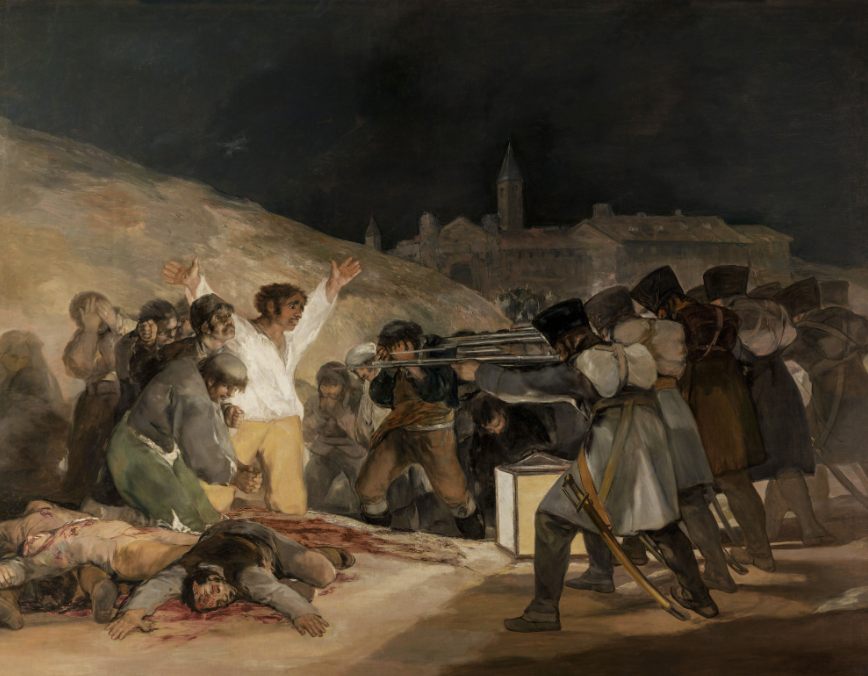
Francisco de Goya, El Tres de Mayo, 1814, Museo del Prado, Madrid.
The resonance between El tres de mayo and The Trial is marked. The membrane separating the art of Goya from the art of Kafka is flimsy. Kafka never mentions Goya in his known papers, though he burned many and others were burnt by his last lover Dora Diamant as he lay dying, and still others were taken later in Gestapo raids on her flat. But perhaps Kafka had glimpsed a reproduction of this canvas of Goya’s—he never went to Spain. Or perhaps each drank from the same subterranean river of universally perfect imagery, visible to them yet clouded for the rest of us. Until they show it us.