

frame 78 April 2026
I Will Miss You, Because I Will Forget You
By Heba Hayek

Heba is a Palestinian author and facilitator. She currently works at a London-based charity supporting higher education in Palestine. Heba holds an MFA in Creative Writing from Miami University, Ohio, and studied Social Anthropology at SOAS University of London.
Heba’s first book, Sambac Beneath Unlikely Skies, won the Creative Award in the 2022 Palestine Book Awards and was chosen as a 2021 Book of the Year by The White Review, Middle East Eye and The New Arab.
I Will Miss You, Because I Will Forget You

From the stretch between North of Piccadilly and Holborn, I barely blinked at the thought that many people might be hearing a child’s genuine laugh for the first time, in a while anyway, but through an Instagram reel. A recording of it was going viral. In my distraction, I remembered when children’s laughter was first recorded on Nokia phones, as a way to challenge each other not to laugh. It was, of course, impossible.
People replaced each other in quick movements at the main stations, leaving crosses and parallels across the royal blue that washed the train seats and traced the lines on the floor. My thoughts were interrupted at King’s Cross when an older woman approached the seat next to me and asked, as she slowly lowered herself to my eye level, Who was here?
“Excuse me?” I smiled, removing my earpods with one hand.
“Who was sitting here?” she repeated, warmly.
I remembered the hands of the person who had been there – how they spent the entire time untangling their wired white headphones before finally plugging them in. I also remembered the relief I’d felt; commutes tend to be brutal without them.
“The young man. Sky-blue shirt.” I pointed at him as he stepped out through the carriage door. I was still holding my smile when he turned around and smiled back from the platform.
“Good,” she said, almost relieved. “That’s my grandson.”
He waved at her, and the doors shut.
I was startled by the resemblance between them – the brown eyes encircled by deep black, the downward-pointing, strangely straight eyelashes. The way she fiddled with her fingers, as if she too were untangling something.
“I cannot see him, however.”
For a moment, I thought she meant she wasn’t wearing her glasses, but her face shifted too quickly between words.
“He’s my whole world.” She looked ahead, chin lifted, her face traced by years I may never know, down to the necklace that seemed to bear the word Rahman engraved on it.
In moments like these, I had long since taken my “oh, I am so sorrys” and thrown them into the most overfilled bin after two years of public, all-consuming, documented loss. And for all the sorrys that might follow, I could not find it in me.
A rush of cold passed through me – that familiar, ghostly voice – and the bass from my earpods rose between my fingers as the words in my throat decrystallised.
“He’s very lucky to be loved,” I said. Her golden hand came to rest on my arm, and she stood to exit at the next station.
No one rushed to take her seat. It stayed filled with her as we neared the working hub of the city, ready to be regurgitated into shades of grey and khaki and ridiculously boring branded vests. I tucked my earpods into my pockets and exited the station.
I don’t know if it was that seat’s first heartache of the day, but I was certain it wouldn’t be the last for either of us. At last, I know – a little too well – that nothing once filled with life is ever lifeless again. And nothing once filled with pain is ever free from it.
Before I’d left for work that day, I had picked up my phone to call a friend who had not been responding, and I received the same accidentally recorded voicemail that I don’t seem to get used to. As the city fell into its own stagnation, I couldn’t shake the train interaction or the voicemail from my head, and I felt somewhat complacent. The only thing I wanted that I could reach for was a window seat.
*
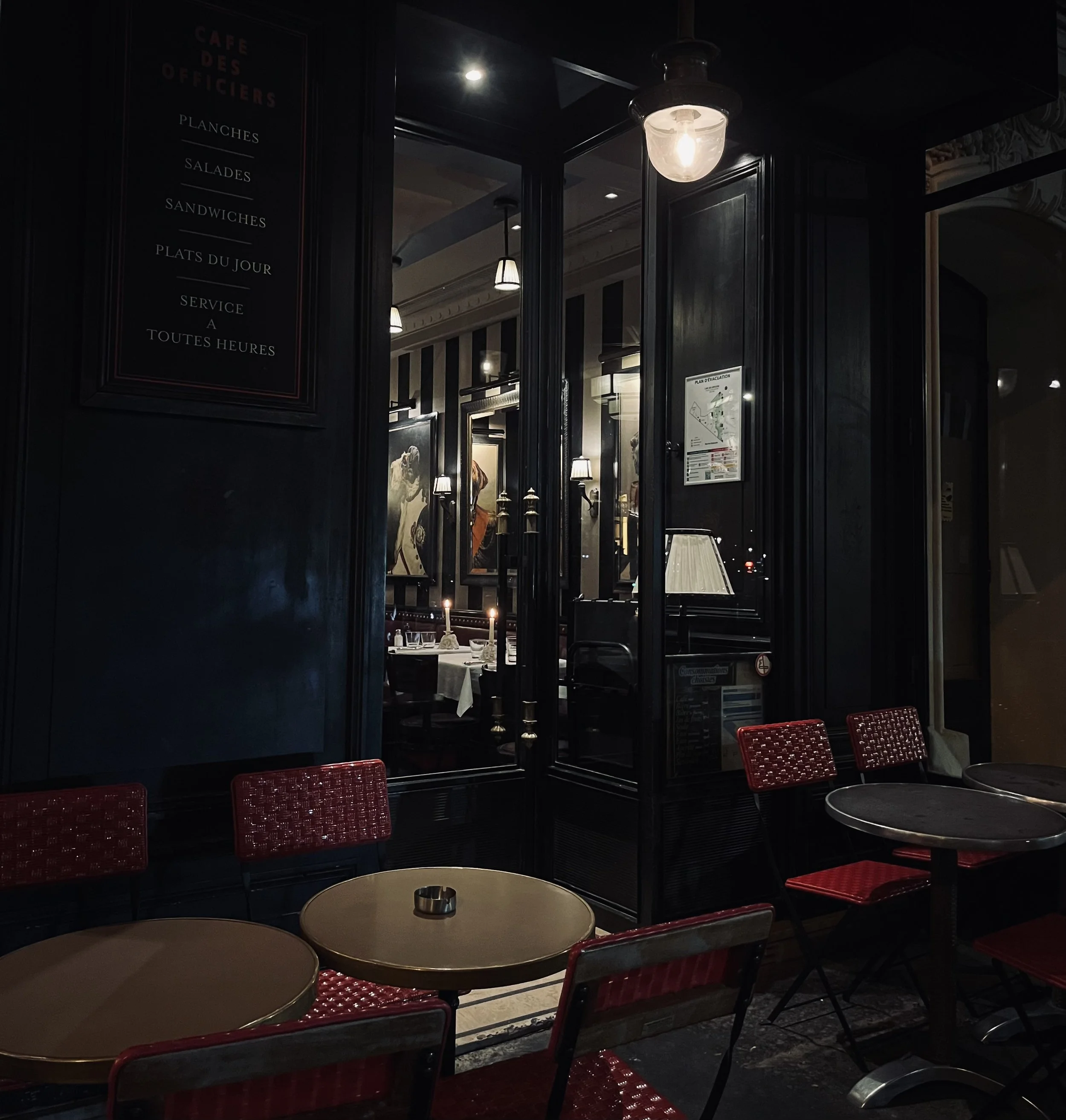
Photo Credit: Heba Hayek
You find out about most things in this life through their absence. You recognise the recurring clunkiness in your chest when you begin each morning trying to unlock your ribcage. The way older sinks don’t merge hot and cold faucets, so you never quite wash your hands in warm water. How you learn what a home is: the farther away you are from it.
I walked for hours to and from the 7th arrondissement every night and every morning over the past two weeks. I wanted to learn the place I inhabit not through its major sites, or even the beautiful riverside that marked the first or last thirty minutes of my walks, depending on the time of day, but through its habits – the way it gathers presence and absence.
Enamoured with the city, and not attempting to hide it, I revisited the same places where coffees, cigarettes, and cards passed through political arguments; poems read aloud at the canal; bike rides along the river; moments when the present felt so self-sufficient it needed neither a witness nor a dream.
All of that unsettled during my night walks. I was searching for what I already know, and that physical manifestation of a nearly instinctive, concurrent knowledge arrived like relief. Places have memories that speak and laugh and downpour. No one can tell me otherwise.
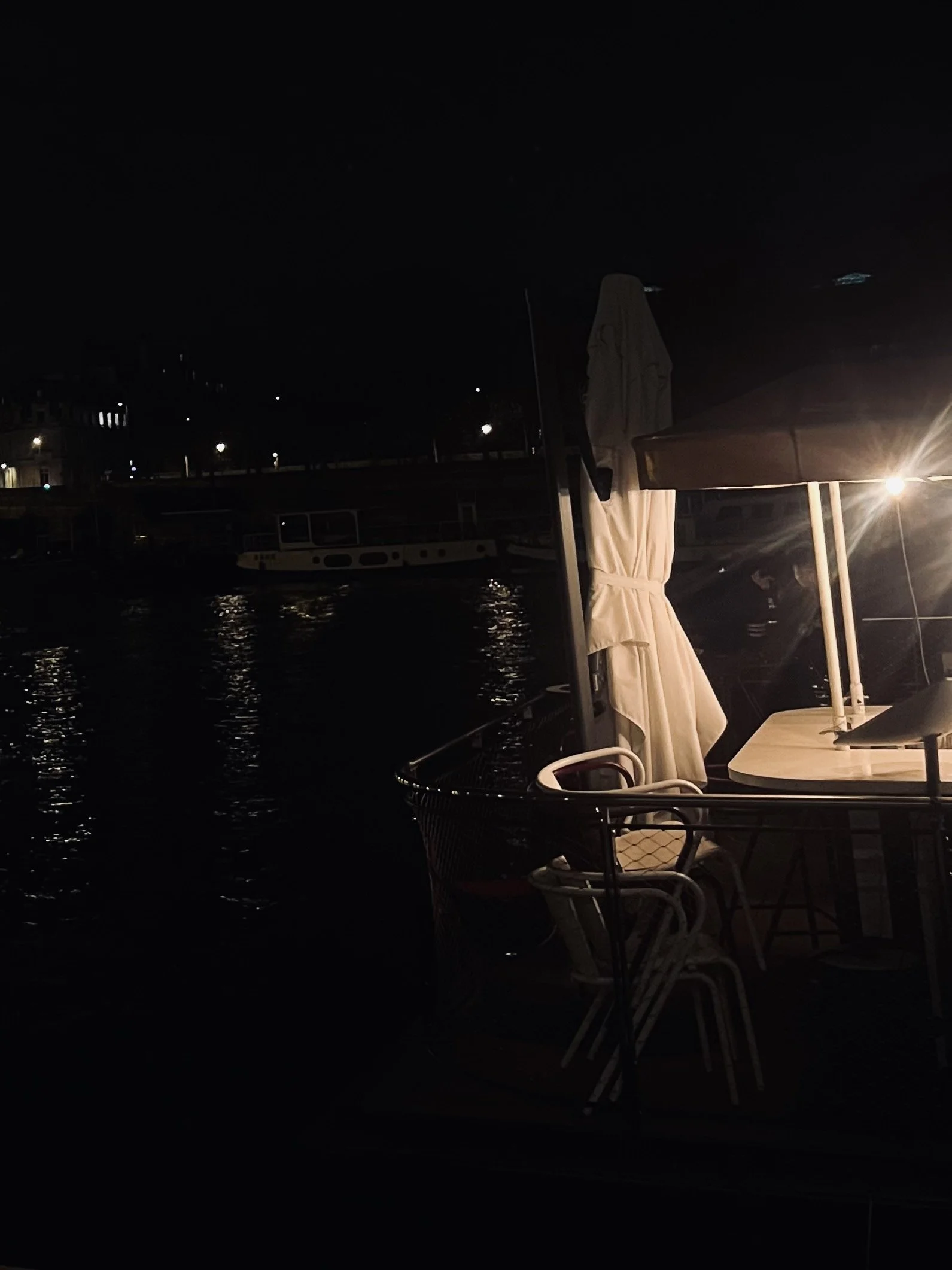
Photo Credit: Heba Hayek
On the river, workers were closing down a boat café, stacking chairs and locking them to the edge. My grandfather had a chair like that one, I thought. A white chair with a half-circle on the back, different from all the others men had outside their houses – often leftovers from street bachelor parties. Most houses in my neighbourhood in Gaza had a chair outside, sometimes surrounded by others when people visited, but always singular by the morning.
I was eight when I sat on a grey cement stone beside my grandfather’s white chair on a rain washed night. My parents were travelling, and I had spent a month at their house. I couldn’t sleep, so I stayed up with him, his company filled with silence except when he sent me upstairs to bring fresh tea. I held a wooden stick fallen from the fig tree above us and attached it to a small car from my brother’s toys, moving it back and forth, tracing shapes.
“I used to be a taxi driver,” he said, seemingly out of nowhere. “Unlike today, there were barely any cars around here, and mine wasn’t even a hire.”
I kept moving the little car, this time more steadily.
“Who is sitting in your little car, and where are they going?” he smiled.
I focused on the car, carefully adjusting the stick so it wouldn’t flip now that Sido had decided to give it passengers.
It was the age of the recurring car crash dream, where I would be driving, barely reaching the brakes, then losing control. My small car suddenly carried a reassuring weight it didn’t have in those dreams..
“Mama and Baba,” I answered. “And you,” I added. “But you’re not driving it.”
“And what stories are they telling you?”
“They tell me they miss me like I miss them, and about the gifts they got me, and the flying.”
“And what am I doing?”
“You’re just there, Sido.”
He told me stories about the people he drove – women in labour, injured people from protests, nights held at checkpoints, the time he hid a boy in the trunk because the military was looking for him and his older brother, and of course, ordinary people carrying ordinary griefs.
I believe that night I got more words out of Sido than I ever did. For most of my childhood, I thought that all his life, he sat on that chair outside his house, drinking mint tea or cracking dried salted watermelon seeds. I could see him moving people across our city, making what he could, which was never enough for the house to become a multi-storey home – though that was more my grandmother’s doing than his.
In 2011, Sido left us very slowly, between hospitals and long nights in his bedroom. His absence came in intervals - stretched and painful, filled with stories we had never heard before and an anger that rarely showed when he was fully with us. He was the first absence I experienced. It was a time when our men got old enough for us to recognise their absence by their empty chairs. When our men got old enough to park their taxis, plant cherished vegetable gardens and raise grandchildren.
In the absence of concrete geography and linearity, my brain traces all the white chairs across the alleys and roads. It moves in a flurry at our house’s doorstep, then at Sido’s, at our neighbour’s, at my uncle’s house around the corner. There is no longer a world where revisitations are possible. We now have to carve out those geographies, to make space for memory, to then grieve.
Could one really grieve in total absence of geography? I don’t know.
I missed Sido. I was a bit disturbed by how long I had not thought about him or even since I’ve thought of any loss that preceded the past two and half years. I felt guilt mixed with relief, like I’d returned a piece of me through that night, but I did not know where to place it in the distortion of it all.
My phone screen lit when a man appeared from inside the boat and mumbled a few French words.
“...madam?” is all I could dissect at first. Then I realised he was telling me to step back so they could close the boarding tramp to avoid trespassers. I waved and turned around.
I stopped at a late-night Monop’ to buy some fruit for breakfast. I was carrying a book someone had sent me years ago to review. I had originally tucked two five-euro notes between its pages, and when I opened it, a small piece of paper slipped to the floor. It read: “I will miss you, because I will forget you this summer term. Love from V.”
I placed the note back inside, paid for my kiwis and oranges, and stepped outside. It took me a moment to remember what I had forgotten. It was a letter one of the children had written for me a few summers ago - perhaps the most honest and sincere thing anyone had ever said to me. I took the long way back to the flat, smiling at the memory of V’s face from that summer we spent mostly in isolation during Covid – between parks and Arabic lessons.
I reached for my phone to take a picture of the note, afraid of losing it again. A message lit up my screen: “I just don’t want to speak to anyone now. I am ok. I love you.”
By then, the lights of the Eiffel Tower were off, and the chairs at the terrace cafés were stacked into quiet, parallel towers. The city had folded into itself. On my walk back, I did what I had done every night for the past three weeks – repeating, in small loops, the little French I had learned so far.
Demain, je passerai la journée au soleil avec mes amis.
Tomorrow, we will search for the sun.
Tomorrow, I will remember you again.
And sometimes, I won’t.
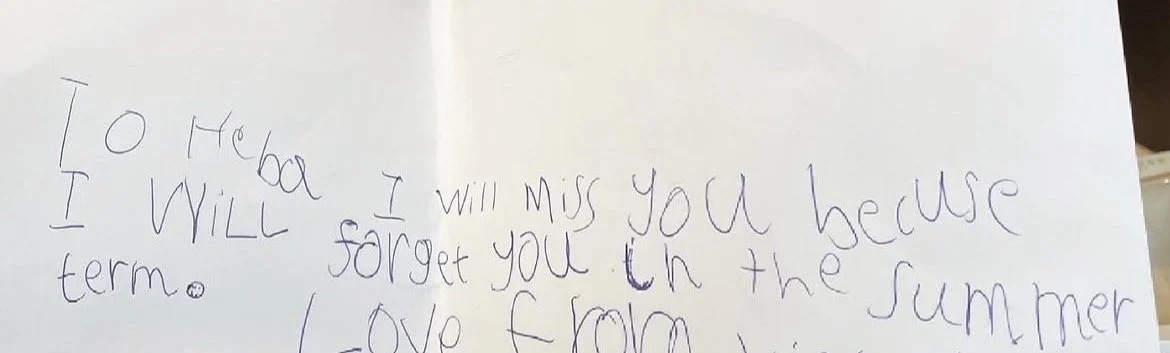
Photo Credit: Heba Hayek