

frame 72 October 2025
The Final Performance
by Gilson Lavis
With thanks to Cy Worthington and Jools Holland
In the second of his Frames for us, legendary drummer and acclaimed artist Gilson Lavis describes his last show with Jools Holland at the Royal Albert Hall, 2024. He first met Jools in 1976, when Squeeze had advertised for drummers to audition. He wildly impressed and so became a successful part of Squeeze. In 1984, he and Jools formed the Big Band, then a big band of two – and Gilson continued on as it grew into the Jools Holland and his Rhythm and Blues Orchestra as it is today. Jools’ autobiography, BAREFACED LIES AND BOOGIE-WOOGIE BOASTS contains many hilarious incidents from their times together, and in an edited extract at the end of Gilson’s Frame, Jools describes their first meeting.

The Final Performance
Standing backstage at the Royal Albert Hall, I felt the familiar weight of nerves settling into my chest. But this time, something else accompanied them—a tingling in my legs, dizziness and fatigue, a sense of tightness and heaviness that had been creeping into my performances for months. I didn’t know it at the time, but I was experiencing the early stages of pulmonary fibrosis. I wasn’t in any shape to be performing, I wasn’t even sure I’d make it to the end of the show alive. Yet here I was, about to step onto the stage one last time.
For sixty years, I'd lived behind a drum kit. From that reckless teenager who left home at fifteen, drowning in alcohol and arrogance, to the man I am today—still struggling, still learning, every day brings fresh challenges. The journey between those two versions of myself had been anything but straight.
Those early years were a blur of excess. I believed I was living freely, that the chaos was somehow romantic, artistic even. What I didn't understand then was that I wasn't free at all. I was imprisoned by my own twisted thinking, by substances that promised liberation but delivered only destruction. Success came anyway—the big stages, the world tours, the validation I desperately craved. But inside, the darkness kept growing.
I hit rock bottom at thirty, broken and alone, my world in pieces around me. Alcoholics Anonymous saved my life then, and again years later when the disease dragged me back down. But sobriety alone wasn't enough. I'd stopped drinking, but my mind remained sick. I was performing recovery the way I'd performed on stage—showing people what they expected to see while hiding what was really happening inside.
Now, decades later, standing in the wings of this magnificent hall, I understood that all of it—the addiction, the recovery, the relapses, the daily work of staying whole—had led to this moment. The two threads in my life were intrinsically linked, and I now felt scared about how bringing one to an end might affect the other.
What was strange, though, was that it hadn’t felt like a particularly momentous occasion. I’d been playing with Jools Holland and his Rhythm and Blues Orchestra since it was formed in 1987 and the whole thing came to an end so abruptly. I agreed to be retired – which, medically speaking was the only option – and that was that. The story ends, not with a bang but with a whimper.
The show that night required every ounce of energy and concentration I could find. The medical tightrope I was walking made each beat more precious, each song more urgent. My body was failing, but my spirit had finally learned to show up honestly. It was by no means perfect, but I got through it. The applause felt surreal. A two-minute standing ovation at the Royal Albert Hall, now that’s not a bad way to say goodbye.
After the final encore, someone shouted that I was needed in the number one dressing room. I moved slowly through the backstage corridors, shaking hands, accepting congratulations, still catching my breath. I knocked on the door and Jools asked me in. Usually when people don’t know what to say in these situations they give you heartfelt handshakes and say empty platitudes. But it wasn’t like that with Jools; we’d been through too much for all that. After fifty years of working together, we enjoyed a shared serving of toad in the hole.
If my retirement from drumming has taught me anything, it’s that just because we move forward in life it doesn’t mean we’re learning. My career has felt at times like a long succession of lucky buffets and scrapes. I keep thinking back that early morning decades ago, when I drove blind drunk and half-asleep into a crash barrier near Dunstable. It was the only ten yards of barrier for miles and miles around, and it should have killed me. Instead, it was a warning I refused to heed for many years. The universe kept offering me second chances, and I kept squandering them until I finally learned to accept help.
This illness loves a healthy body and a sick mind. Today, I work to keep both as well as I can. There are no perfect victories, no final triumphs over my shortcomings. Codependency still pulls at me. Fear lurks just a breath away. But I've learned to face these truths without shame, in rooms where honesty matters more than image. I’m deeply grateful to my darling wife Nicky, but in many ways recovery from addiction is a solitary venture.
The Royal Albert Hall was my last stand behind the drums. But it wasn't an ending—it was a release from a prison of my own making, one beat at a time.
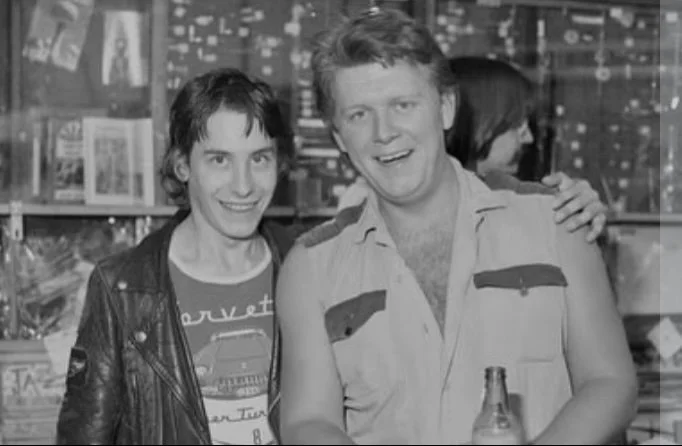
Gilson Lavis and Jools Holland
The Drum King Enters from BAREFACED LIES AND BOOGIE-WOOGIE BOASTS by Jools Holland
It has to be said that drummers are the most important part of any group, the final piece of the equation. Theres no group that’s had any success without a good drummer.
Gilson had excitement and drive and he blew all the other auditioning drummers out of the water. He was brilliant.
He was a bit older than the rest of us and seemed in many ways, a bit wilder. At one of the first shows, his having joined Squeeze, there was this audience member sitting thoughout the whole of our set with both arms raised in the air and two fingers raised on each hand, waving relentlessly, from side to side which was a bit annoying. In the bar afterwards, Gilson suddenly flew across to him, knocked him to the ground and stood above him holding his fist above his head saying ‘Is there something you want to say?”
“no no…”
‘do you want to say sorry??’
“yeah”
“are you going to do that again?”
“no. I’m not.’
“Right. Don’t. See you later then.”
We really warmed to Gilson after that.
